
We all know that projects, decisions, and opportunities take time. But what we talk about less is what happens in the silence between the messages — when people are left waiting, wondering, and stuck.
Over the past few weeks, I’ve found myself in that all-too-familiar place — waiting. A few big decisions are hanging in the air, and I’m poised, ready to act, plan, and move things forward. But without communication, I can’t. And I know I’m not alone. Across teams, industries, and roles, so many of us find ourselves stuck in this same limbo — where progress is possible, but silence holds everything back. The longer the wait, the more that silence becomes more than just a gap in the timeline — it becomes a loss of momentum, of clarity, and sometimes, of confidence.
🕓 When silence delays progress
When people don’t respond, ideas stall. Plans are left in limbo. Time is wasted.
You can’t build a budget, plan a timeline, or commit resources if the basic parameters haven’t even been confirmed.
In critical projects, this kind of delay doesn’t just block progress — it can carry real risk.
You’re often left balancing two uncomfortable options:
- Do you wait, losing precious time and momentum?
- Or do you press ahead — potentially heading in the wrong direction?
Both come at a cost. And if you guess wrong, the result could affect more than just the project.
It can impact your credibility, your relationships, and your own professional reputation.
Delayed communication doesn’t just hold up logistics — it creates doubt. Not just about the decision, but about the people behind it.
Is this a one-off delay, or a sign of things to come? If this is how communication begins, how will it hold up under pressure?
“What derails momentum isn’t delay — it’s a lack of response.“
✅ Acknowledgement matters more than you think
When someone says, “I’ll get back to you next week,” and then doesn’t — it doesn’t just create frustration, it creates doubt.
Of course, sometimes things slip — we’re all human. But consistently missing promised updates without so much as a check-in or holding message says something. Whether intended or not, it signals that the other person’s time, work, or priorities don’t matter.
Even a simple “Thanks — I’m on it, will come back to you next week” goes a long way. And if circumstances change, let them know. Acknowledgement is free — silence can cost you trust.
And here’s the kicker: if it was your CEO waiting for an answer, or a high-profile client, would you still leave them hanging?
The truth is, most people wouldn’t. We manage up more consciously than we manage across or down — but that inconsistency creates cracks in your professional reputation.
Responsiveness isn’t just a courtesy. It’s a reflection of your reliability, your respect for others, and your ability to follow through.
💬 Remote and Hybrid Working Requires Stronger Signals
In an office, silence often has context — you can glance across a desk, ask for a quick update, or catch someone over lunch. But when working remotely or in hybrid environments, that visibility disappears. Communication must be intentional — because silence becomes ambiguity.
A few guiding principles can really help:
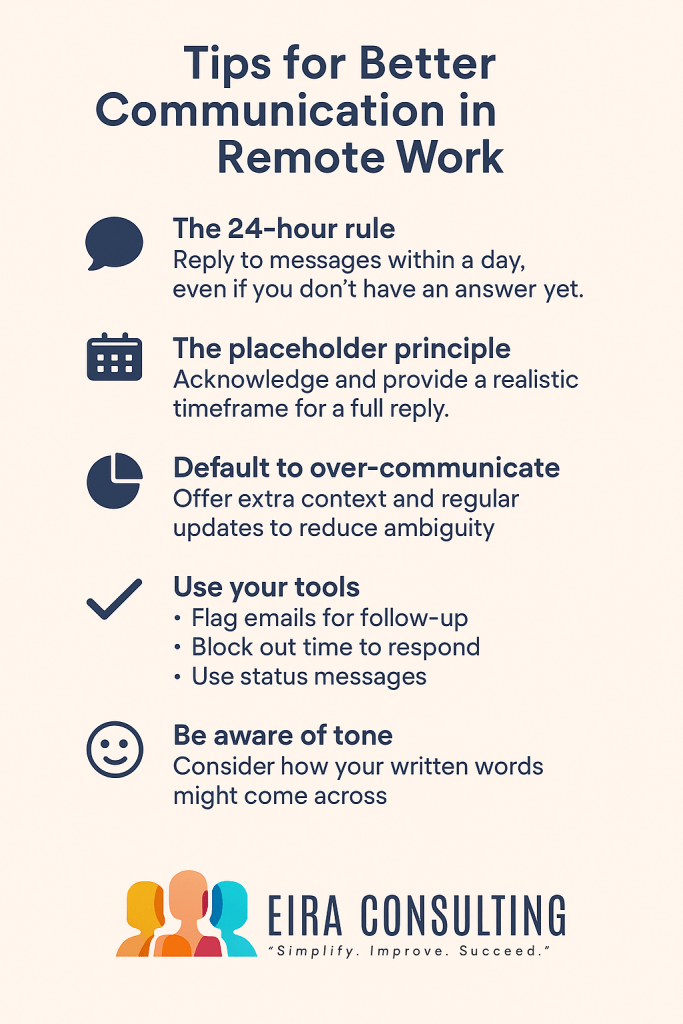
Be aware of tone: When there’s no body language, a message that feels neutral to you might seem dismissive to someone else. A few extra words of context or warmth can make all the difference.
The 24-hour rule: Always respond to messages within 24 hours, even if you don’t yet have the answer. A quick “Thanks — I’m looking into this” maintains momentum and shows respect.
The placeholder principle: If you know your response will take time, acknowledge the message and give a realistic timeframe for your full reply. Then, stick to it. If the timeline slips, update them.
Default to over-communicate: In the absence of visual cues, it’s better to give more context than less. Even a short update — “Waiting on final figures, should have them by Friday” — shows that things are moving.
Use your tools:
In Microsoft Outlook, flag emails for follow-up or add them to your To Do list.
Use calendar notes or time blocks for when you plan to respond — treat responses like any other task with a deadline.
Consider using Teams status messages to signal when you’ll be slower to respond or when you’ll catch up.
💡 Leadership Insight:
In any organisation or project, communication isn’t just a skill — it’s a responsibility. Silence may not always be deliberate, but it has consequences. When leaders don’t respond, they don’t just delay action — they damage trust.
But the opposite is also true: when leaders communicate clearly, acknowledge promptly, and follow through consistently, they build credibility. People begin to associate you with reliability, respect, and clarity. Over time, that becomes your reputation.
Being responsive and courteous might seem like a small thing — but it cements you as someone who leads by example.
It’s not about being perfect. It’s about being present. Showing others that their time matters, that you keep your word, and that you’re not just asking for accountability — you’re modelling it.
That’s the kind of leadership that earns trust — and keeps it.

 eiraconsulting.co.uk
Leave a comment